THE controversy surrounding the 2026 William Jones Cup took another turn after Chinese Taipei Basketball Association (CTBA) vice chairperson Wen Da Pei accused someone from the Strong Group Athletics-Pilipinas of lying about the tournament format.
Pei maintained that SGA-Pilipinas had been informed of the competition rules before the tournament and claimed that the Philippine delegation was aware of the format from the beginning.
“When I went to the venue yesterday, I emphasized that the Philippines knew the competition format from beginning to end,” Pei said.
“Everyone before the competition believed that the Philippines would advance, including the Philippines themselves,” he added.
Pei then made a stronger accusation against the Philippine side.
“They can use a loophole, but they cannot say it’s a lie,” he said. “Obviously, there was someone on the Philippine team who lied, but at this point, there’s not much good to say about it.”
Pei’s remarks came amid widespread criticism of the tournament format, which guaranteed Chinese Taipei Blue a place in the semifinals regardless of its Group A standing.
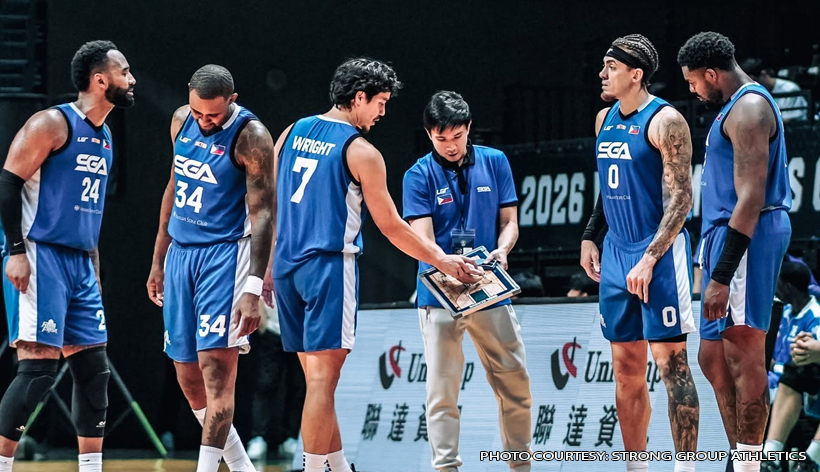
SGA-Pilipinas finished the group stage with a 5-1 record but was eliminated from semifinal contention after South Korea’s Wonju DB Promy claimed the lone qualifying spot through the tiebreaker system.
Chinese Taipei Blue, meanwhile, advanced despite finishing the group stage with a losing record.
Pei acknowledged that the tournament format had shortcomings and said the CTBA should review the rules after the competition.
He argued, however, that the approved competition regulations could not simply be changed while the tournament was ongoing.
“Everyone who passed the competition regulations at the team leaders’ meeting — those regulations are the ‘constitution’ of the tournament,” Pei said.
“Even if we now know that there are shortcomings, we still have to continue and review them after the tournament ends.”
According to Pei, changing the rules in the middle of the competition would undermine the credibility of the event and establish a precedent where regulations could be altered whenever problems arise.
He stressed that the CTBA’s position was not an attempt to avoid accountability.
“The association is not refusing to admit its mistakes,” Pei said, adding that the organization must uphold what he described as the final red line in conducting a legitimate sporting competition. “If we were wrong, then we were wrong. There’s no denying it.”
Pei also said the controversy should not be viewed solely through the lens of ticket sales, television ratings or the performance of Chinese Taipei Blue, but rather through the broader principle of maintaining consistent competition rules.
The CTBA has previously acknowledged the criticism surrounding this year’s format and said it would review and improve the tournament structure and scheduling for future editions. (Adrian Co)